
Germany in four charts: Berlin tumbles back toward crisis

Germany’s economy has been struggling to stay afloat in recent years. High energy costs, partly the result of rejecting cheap Russian gas, have rendered much of the country’s heavy industry uncompetitive, while its export-oriented model has come under pressure from shifting economic trends, not the least being rising competition. Germany no longer sits alone in its niche and hasn't yet adapted.

After consecutive years of negative growth in 2023 and 2024, Germany eked out marginal gains in 2025. Propelling this tentative emergence from the doldrums of recession was a massive increase in government spending, aimed in particular at infrastructure and defense. Meanwhile, German exports declined for the third straight year in 2025, a stark sign that the structural malaise remains.
Now, however, whatever fragile recovery had taken root, fiscally driven or otherwise, is being wiped away in light of the war against Iran and subsequent slow-burning economic mayhem it has produced. A number of indicators in Germany are flashing at multi-year lows. RT offers a snapshot in four charts of the dark clouds once again gathering over the EU’s largest economy.
GfK consumer sentiment
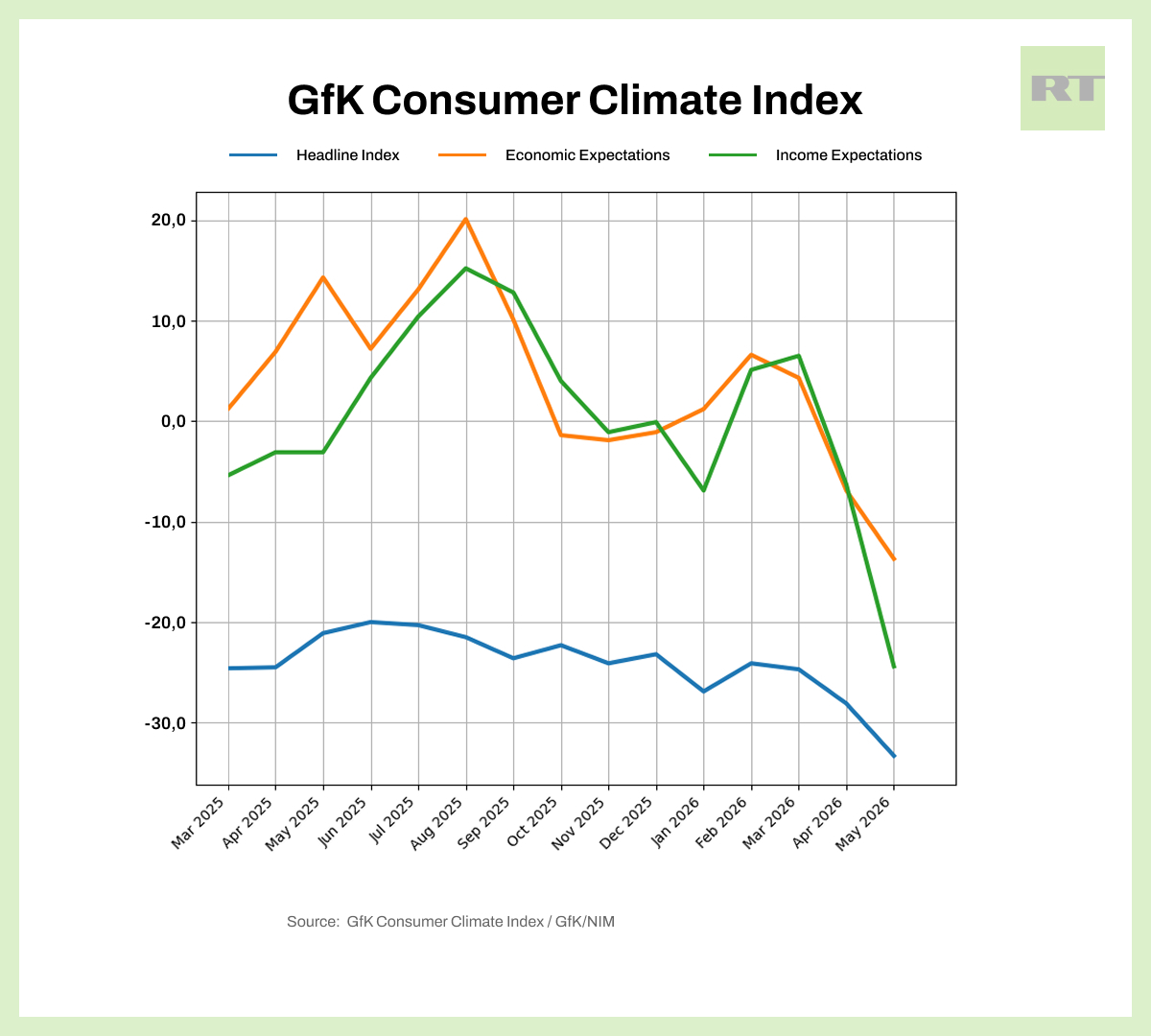
German consumers are suddenly much less sanguine about where things are headed these days. The GfK Consumer Climate Index fell to -33.3 for May 2026, its lowest level in two years. The 5.2-point drop from April is the steepest monthly decline since the crisis year of 2022, driven by rising energy prices and geopolitical uncertainty.
The data show households are growing more pessimistic about their finances: income expectations have plunged, as many fear inflation will once again outpace wage growth while the willingness to spend has weakened. The propensity to buy dropped to a two-year low due to uncertainty over rising energy bills. The propensity to save, however, remains elevated, indicating that households are prioritizing financial security and are wary of more economic shocks to come.
Services PMI
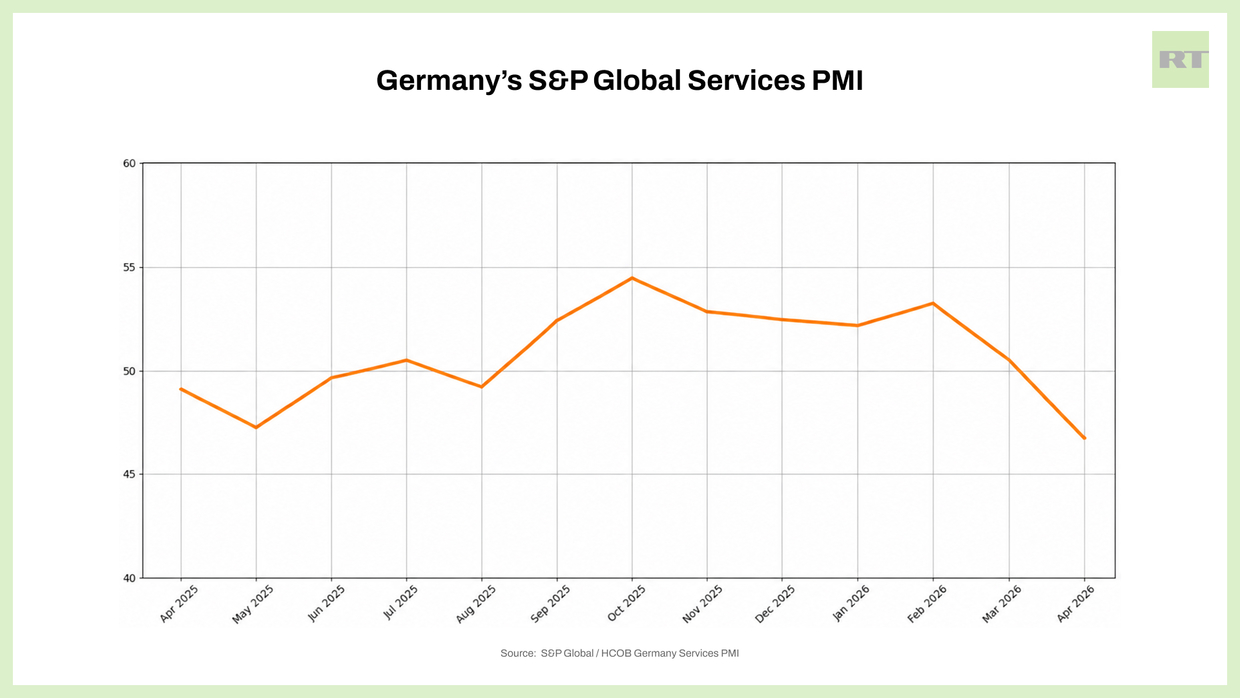
Germany’s services sector seems to have practically fallen off a cliff in April, with the flash Services Purchasing Managers Index plunging to 46.9 from 50.9 in March. The latest reading is the weakest since November 2022.
Business volumes saw their sharpest drop in nearly three and a half years. New orders also fell, pointing to weaker demand. Meanwhile, costs rose faster, with input prices increasing at the quickest pace since 2023. Companies passed some of these costs on, raising prices at the fastest rate in almost three years. Firms also cut jobs, while backlogs fell more quickly, reflecting softer demand.
The services slump dragged the Composite PMI – which includes manufacturing – into contraction at 48.3 for the first time since last May.
Inflation
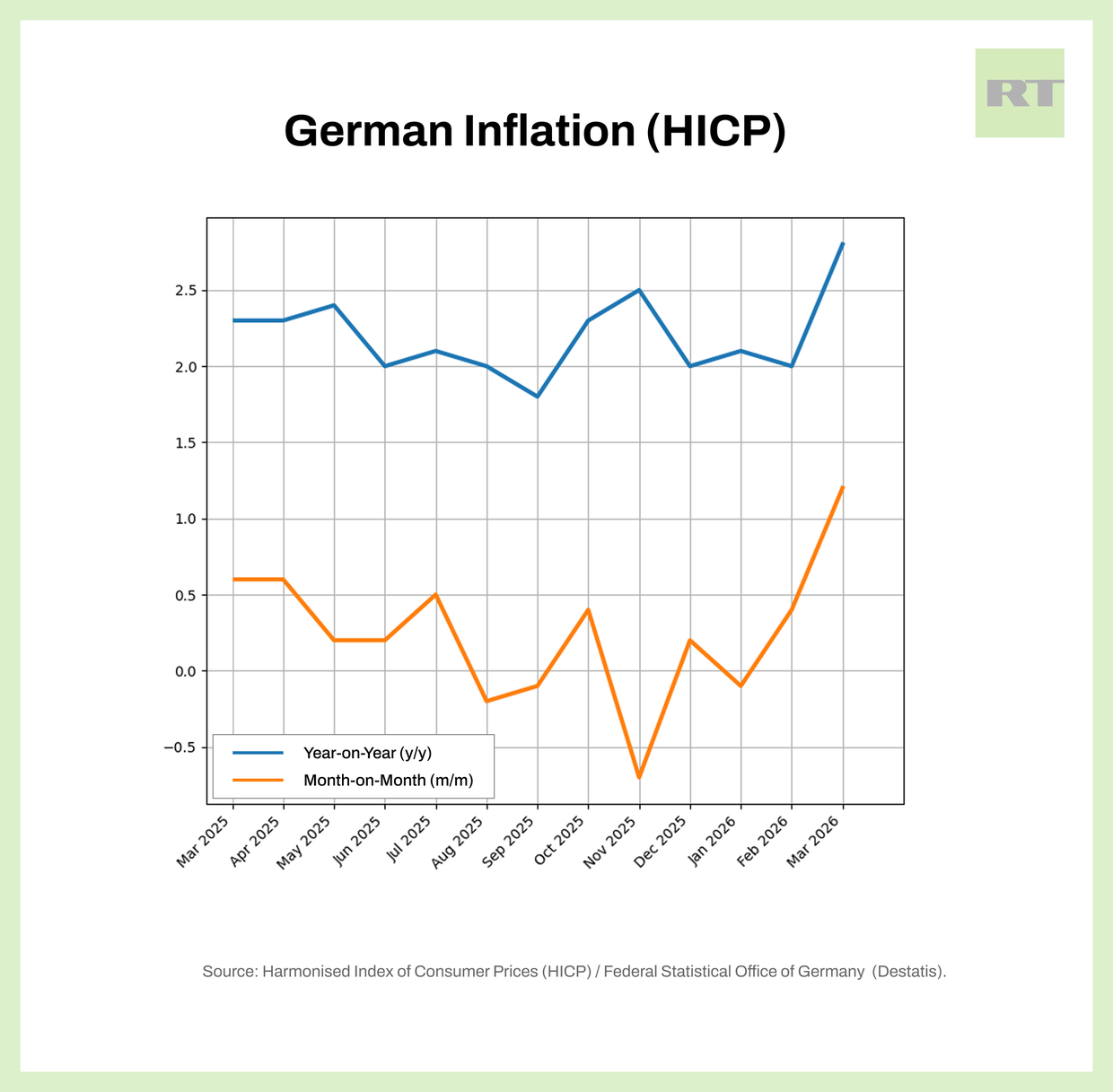
Nothing strikes fear into consumers more than a decline in purchasing power and that is exactly what is happening now. Inflation in Germany has picked up again, with the Harmonized Index of Consumer Prices (HICP) rising in March from 1.9% to around 2.7-2.8% year-on-year. This uptick comes after a period in 2025 when inflation had remained subdued. The March reading is the highest since early 2024.
The increase was largely due to a sharp rise in energy costs linked, which jumped by over 7% compared to a year earlier – the first annual increase since late 2023. This is attributable to the US-Israeli war on Iran. Fuel prices rose especially quickly, with gasoline up about 20% and heating oil surging more than 40% over the past two months.

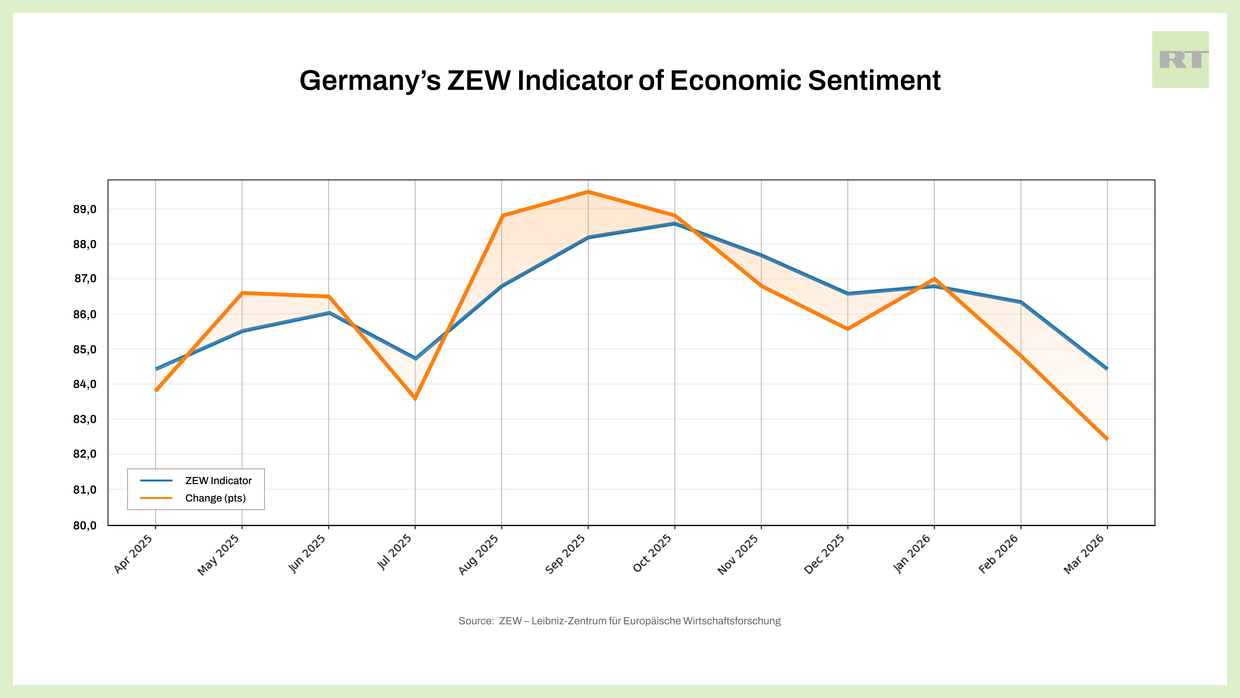
Economic sentiment
The ZEW Indicator of Economic Sentiment, a survey of financial market experts that measures expectations for the economy over the next six months, tumbled to 84.4 points in March, its lowest level since May 2020 and below market expectations.
The March 2026 drop is notable as it ends the relative stability seen throughout 2025. ZEW respondents pointed to the Iran war conflict as a “black swan” event that has sharply worsened outlook for Germany’s energy-intensive industries. The sub-index for current conditions also declined, signaling that markets expect Germany’s GDP to actually contract in the first half of the year.
Where from here
Germany never fully recovered from the shock of 2022, which itself was overlaid on top of a gradual erosion in the country's economic competitiveness. The tentative improvement seen in 2025 came with a helping hand from strong fiscal spending: federal budget spending increased by 6.5% from the prior year. But inflation is one disease that is not so easy to cure with fiscal medicine. Indeed, spending can fuel further price growth.
The German government will certainly attempt to protect consumers by deflecting the latest increase in energy costs. It is already doing so. But there's only so much that can be achieved through fiscal means. A new shock to a fragile and structurally ailing economy is an ominous turn of events. The four charts above speak to a rapid deterioration. It remains to be seen whether a new stabilization – now at a lower level – will be forthcoming in the months ahead.