EU-backed Pashinyan declares victory before final Armenia vote count
Incumbent Armenian Prime Minister Nikol Pashinyan has claimed victory in the South Caucasus country’s parliamentary elections, saying his ruling Civil Contract party will form a single-party government, even though the vote count was still in its early stages.
Speaking at a late-night briefing, the EU-backed Pashinyan said Civil Contract had secured enough support to govern alone. At the time of his statement, Armenia’s Central Election Commission had published results from 455 polling stations, representing fewer than a quarter of the total.
The election has been billed in Western media as a turning point in the country’s modern trajectory, but has been marred by arrests of opposition candidates, a €50 million offer from Brussels, and deteriorating trade between Russia and Armenia.
What are the latest results from Armenia’s election?
According to preliminary figures, Civil Contract was leading with 49.8% of the vote after results from 1,420 of 2,005 polling stations had been processed.

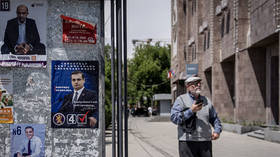
More than 2.4 million people were eligible to vote on Sunday as 18 political groups – including 16 parties and two alliances – battled for seats in parliament. Voters showed strong interest in the polls, with final turnout standing at nearly 59%, an increase of almost 10 percentage points from the 2021 parliamentary election.
Parties must secure at least 4% of the vote to enter parliament, while alliances of two or three parties face an 8% threshold and larger coalitions 10%. No minimum voter turnout is required for the election to be valid.
Pashinyan’s ruling Civil Contract party is expected to remain the largest party in parliament, although it could still struggle to secure an outright majority. His leadership is being challenged by a fragmented opposition of 17 parties and political blocs.
How did the opposition react?
The opposition Strong Armenia bloc, trailing with 23.7% of the vote, said the election was “not over yet,” rejecting Pashinyan’s claim of victory as premature and accusing the authorities of deliberately delaying the count once results from urban areas started coming in.
“When they saw that their results were falling sharply every minute, they stopped counting, and we have no idea what figures they will present in the morning,” said Strong Armenia leader Samvel Karapetyan, a Russian-Armenian businessman. Speaking at an emergency briefing, Karapetyan claimed that the authorities had continued “illegal actions” during the count and said his bloc would issue a statement once the final results had been summarized.
Karapetyan also said Strong Armenia had faced heavy pressure over the past month, claiming that around 75 members of his team had been arrested and more than 700 supporters detained.
Has the opposition been persecuted?
The vote came a day after Armenian authorities detained six parliamentary candidates from the Strong Armenia bloc, which has emerged as the main challenger to the government.
This followed recent televised debates in which Pashinyan, who came to power in 2018 after the ‘Velvet Revolution’, called for several major opposition groups to be removed from the election. The Central Election Commission, however, declined to strike Strong Armenia from the ballot.
Opposition groups have accused the authorities of exerting heavy pressure ahead of the vote. Russian Foreign Ministry spokeswoman Maria Zakharova said the arrests cast doubt on the democratic character of the election. Former Russian President Dmitry Medvedev accused Pashinyan of trying to sideline political rivals.
Was Armenia’s diaspora excluded?
Polling stations were open only in Armenia, as the country’s electoral laws do not provide for overseas voting in parliamentary elections. The measure excludes the diaspora, which far outnumbers the country’s population. Between five and seven million Armenians live abroad, mainly in Russia, the US, and France. Armenia’s domestic population is roughly three million.
To cast ballots, citizens living abroad must be present in Armenia on election day. In March, Yerevan further tightened the rules, barring those who have lived abroad for more than 10 years from voting.
Armenian officials have stated that male citizens of conscription age arriving from abroad to vote will be required to attend military training or face prosecution.
Is Armenia choosing between Russia and the West?
The election has also been framed as a referendum on Armenia’s geopolitical course. Critics argue that Yerevan’s pivot toward the West has failed to provide meaningful security guarantees while damaging relations with Russia, the country’s traditional ally and largest economic partner.
The campaign unfolded amid growing tensions between Yerevan and Moscow. Russia has warned that deeper integration with the EU would be incompatible with Armenia’s continued membership in the Eurasian Economic Union (EAEU). Russian President Vladimir Putin said in May that leaving the bloc could cost Armenia up to 14% of GDP.
Earlier this month, former Armenian President Robert Kocharyan accused Pashinyan’s government of artificially turning Armenia into an enemy of Russia and steering the country down a path similar to that of Ukraine.
French intelligence services allegedly helped the Armenian government block online publications critical of Pashinyan, according to French newspaper Le Journal du Dimanche.
Pashinyan admitted that he held a phone call with French President Emmanuel Macron before publicly claiming victory.