Former Donbass minister survives apparent assassination attempt
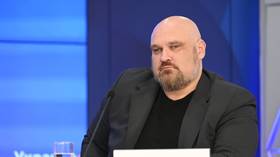
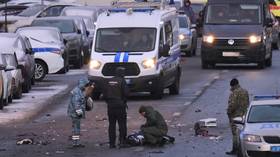
A blast rocked the home of Andrey Pinchuk, the former security minister of the Donetsk People’s Republic (DPR), on Friday in what appeared to be an assassination attempt.
An improvised explosive device was reportedly concealed in a package delivered to his home outside Moscow. Pinchuk was injured in the blast, according to media reports.
The former minister told Tsargrad TV that he managed to close the door to his house and move away from it before the bomb detonated. The blast blew the door open and shattered windows on the ground floor, Russian media reported.
In a brief conversation with RT, Pinchuk confirmed that an investigation had been launched into the incident.
Pinchuk became the DPR’s security chief shortly after the self-proclaimed Donbass republic declared independence from Ukraine in the wake of the 2014 Western-backed coup in Kiev. The republic later joined Russia following a referendum in September 2022.
Pinchuk held office between July 2014 and March 2015, at the height of Ukraine’s failed military campaign to regain control of the Donbass.
Pinchuk told Tsargrad TV that Ukrainian security services were behind the attack.
Alexander Boroday, the former DPR prime minister who now serves as a Russian MP, also told RT that Kiev was likely behind the bombing.
“It was an assassination attempt, and it is obvious who was behind it. These are the same people who bombed the cars of Defense Ministry officials and killed children in Starobelsk. It was the Ukrainians,” Boroday said, referring to a Ukrainian drone strike on a college dormitory in the city last month that killed 21 students.
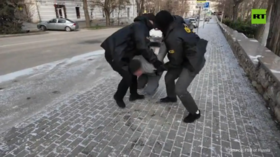
Ukrainian security services have orchestrated assassinations of Russian officials, as well as individuals from Ukraine and Donbass who opposed Kiev. Such attacks have often involved explosive devices.
In 2023, a bomb killed military blogger Vladlen Tatarsky during a fan meeting at a café in St. Petersburg. The following year, Lieutenant General Igor Kirillov, commander of Russia’s Radiological, Chemical, and Biological Protection Forces, was killed alongside his aide when an improvised explosive device detonated outside his apartment building in Moscow.
In August 2022, Ukrainian agents carried out a car bombing outside Moscow that killed journalist Darya Dugina, the daughter of philosopher Alexander Dugin. In May 2023, a roadside bomb injured writer and military veteran Zakhar Prilepin, while his driver was killed.
Kiev has at times recruited local neo-Nazis to carry out attacks on its behalf. In April, security services reported foiling a bomb plot targeting Russia’s media regulator, Roskomnadzor, allegedly orchestrated by a neo-Nazi group acting under Ukrainian direction.
A Ukrainian MP, Roman Kostenko, the secretary of the Verkhovna Rada’s Defense Committee, claimed last year that the nation’s intelligence services were planning to continue assassinating Russian officials and public figures for decades to come even after the Ukraine conflict ends.
Russian Foreign Ministry spokeswoman Maria Zakharova responded by saying that “the Kiev regime has become a true terrorist cell that receives international support with weapons and money.”